/ro͞ot akˈsesəbəl


1. In computing, granting full permissions to manipulate all files or programs; superuser


LABRARY popped up in the heart of Harvard Square.  It didn’t take long until we realized the space was perhaps of the most valuable thing we had.


View Larger Map
People wanted to borrow it. As soon as we opened up the doors, the inquiries came in.  Folks wanted a cool space to use for their own purposes.


In computer system administration there are those trusted enough to be superusers.  Superusers have root access to the server, they’re trusted with the keys to make any change to any file.


In handing over the keys to 92 Mt. Auburn, we were promoting certain users to superusers.  They could borrow the space for their purpose outside our normal operating hours.


This is not a new idea. It’s the community room concept, just taken much further.

It worked especially well because we were a pop-up, disconnected with a larger library. But what if libraries were to create storefront labs, lock-off-able from the rest of the library with their own egress?

Concept sketch of a storefront, root-accessible lab


I went to IDEAS CITY on a kind of field trip.  I wanted to see the things people’ve been thinking about and wanted to see how they communicated their ideas and projects in a “festival-like” fashion.  It was also an excuse to get down the city and see friends.   I’m using booth 16, The Walk Exchange as a case study, they just did such a great job.


Couple things


1) SMILE: Welcomed with a smiling face. Always a good start.


2) Cool Place-setting They had a really cheap, lo-fi table describing the days activities.  They full text describing the walks that they were doing that day taped to the center of a Kraft-paper covered table.  Radiating from the center were fun, highly visual descriptions of the walks that added a whole different voice to each of the course (walk) offerings.  It just woke up the whole table.  It felt like marginalia.


3) Bibliography On their “About us” hand out, they had the traditional copy describing who they are, what they do, etc.  But on the reverse side, they had this wonderful “Readings on Walking” list.  It’s a bibliography.  A bookshelf.  And in going through it, I immediately felt a much, much deeper connection to The Walk Exchange because I knew where they were coming from.   Many of the texts they listed were ones that I liked or was curious about.  Describing who you are through the lens of what you’ve read is extremely efficient, no-ego, and it sets a generous, open tone.

TO DO: put bibliography on this site.

Nice you guys.  Super cool.


The Hobby Shop at MIT is in its 75th year.  I was a grad student at the MIT Media Lab, which has an amazing shop with every tool I could want, but I would go to the other side of the campus to make things at the Hobby Shop. I always felt welcomed there.  And I knew I could ask any dumb question.  Never judgement, just encouragement. This culture is explained really well in the video:

“If I’m coming in as a beginner, and I don’t know how to use a mill or I don’t know how to use a lathe, but I do need to use it, then all I have to do is ask one of the senior members and say, “Hey look, can you help me with this?” …[and] no matter what we’re working on if someone else needs help, we stop and teach them how to use the machine.  Because that’s how we learned, and we want to pass on that ball.”

Folkers Rojas, President, MIT Hobby Shop Club

I think there is a lot to learn from this place in thinking about (academic) LABRARIES:

  1. Open to (nearly) all – Open to students, graduates, faculty, alumni & staff.
  2. Non-departmental – Open to all department students
  3. No power dynamic – Meet faculty, undergrads, etc.  on a very casual basis
  4. Interest – People show interest in others works
  5. Learning from each other – You don’t rely on help and advice only from the shopmaster, rather, everyone else around you is your first ask.  
  6. Not tools, culture – I didn’t care that the tools at the Hobby Shop may be older, the culture made it worth the trip.  


YTA Architects / Find original post here

YTA’s “Bibliotheca Digital”, or single family media room and it’s corresponding explanation — captured something that I’d been feeling.

Two excerpted comments of theirs really resonated:

“This library …created a space where high-tech contrasts with raw matter …creating dialogue and balance.”


“vintage elements maintain the memory of the analog…”

There are two oppositions here:

  1. honest, slow physical materiality vs. fast digital slippery-ness
  2. old (mechanical) technology  vs. new technology (black box / indistinguishable from magic)


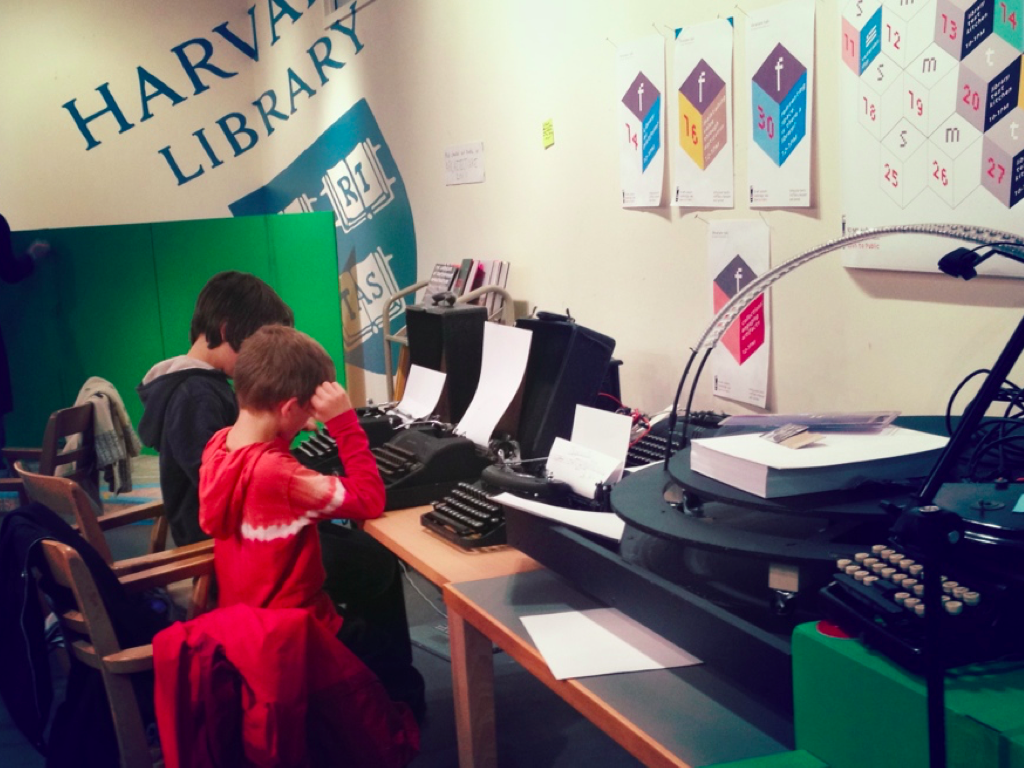
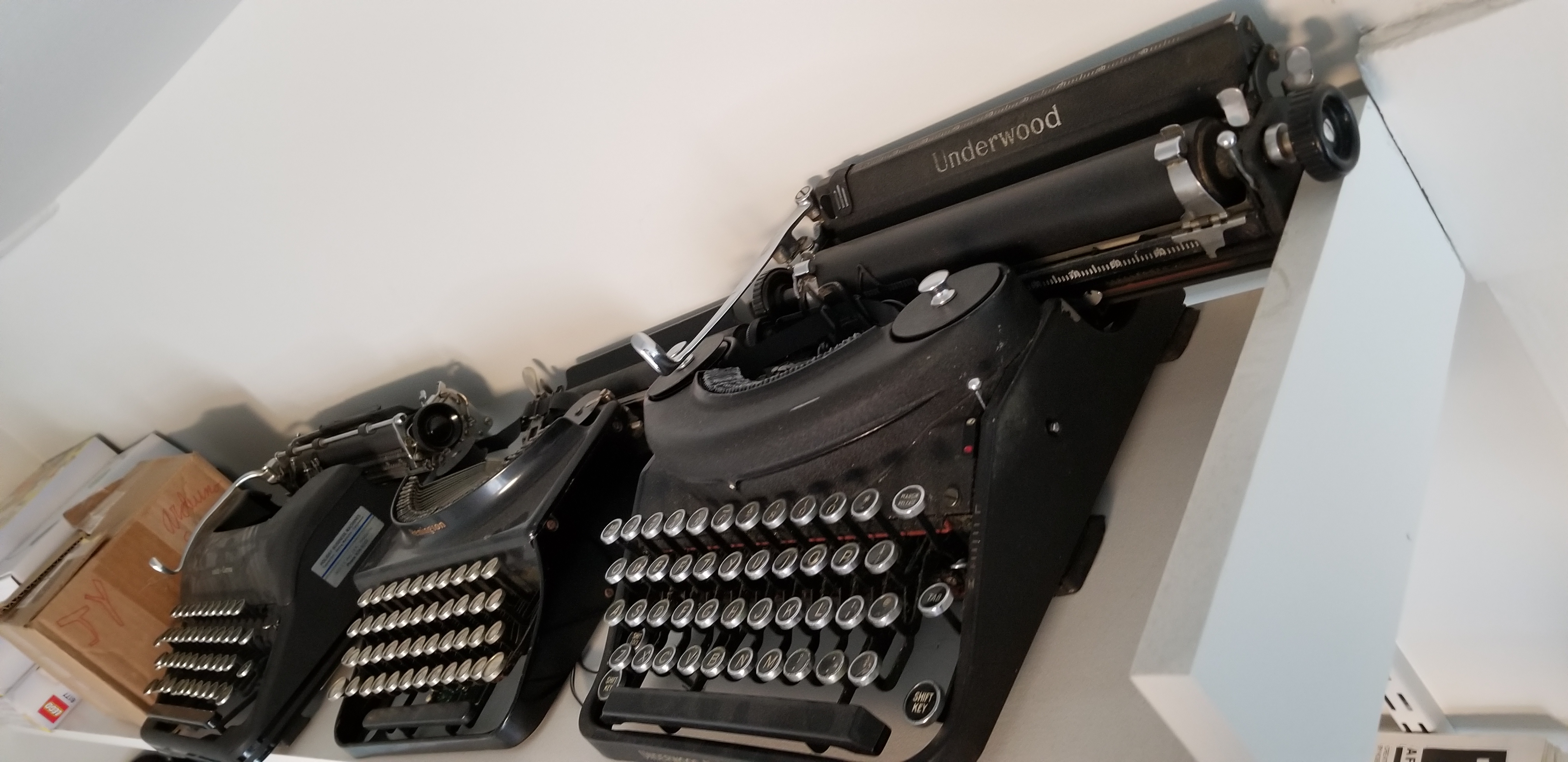
It was amazing how popular these typewriters were at the LABRARY:


The relationship between online and offline came up in many different forms at LABRARY. How should LABRARY or any other physical environment live both online + offline? this is what I mean by hybrid space.

Notes from the week

VOICE
How can you give a space a recognizable voice. Here’s a sketch (recorded in my office) of a dual-feed scenario with a birds-eye web cam and some color manipulation.

HD Webcams are now cheap enough ($60) that you could instrument an environment with multiple. Another tack which would give you greater image control would be to get a Canon Powershot ($160) or two, tether them so they could record directly to your hard drive, and drive their recording with the open source CHDK software.

TEXT/IMAGE INSPIRATION

Expanded Cinema, Gene Youngblood:

Gene Youngblood at SAIC for the effects and visuals, rather than the content.

Exploding Plastic Inevitable – The Factory Andy Warhol

INTERFACE

The idea here is two concurrent “streams”, one capturing the current scene (or recent past), the other documenting an online discussion. Each moves through time at its own pace.

On the discussion board at right, the goal would be to blur the feel of a blog, discussion board, and mailing list. Very often there’s an implicit heirarchy, blogs are where the less frequent, authoritative posts are made by a limited population. Discussion boards are filled with back and forths between community members and visitors. Optimally it would read as a blog anybody could write to.


It’s been a little tough reaclimating since LABRARY / Library Test Kitchen Fall 2012. A lot of energy was put into that endeavor by a lot of people. I threw together a draft video of the LABRARY experience for those that weren’t able to come by:

LABRARY – Draft - from Harvard Library Innovation Lab on Vimeo.

We’re not running this class this Spring, but we’re still meeting as a staff. Work will still be moving forward, first steps will reflecting on lessons learned and bringing the student work to the forefront of the website so stay tuned.

In the meantime:

http://librarytestkitchen.org/talks/cooper/outtakes.html

I visited a class at Cooper Union yesterday. These are the outtakes which contain some of the things we’ve been thinking about/looking at lately (in the form of a website/slide show using Deck.JS built by one of LiL‘s collaborators, Caleb Troughton). The maps project is the original stackview, something I did a while ago, the library radio station project, www.thelibrary.fm, is a collaboration with Matt Phillips from LiL)


Coming up on December 5, 5 pm:

LIBRARY FUTURES: Mohsen Mostafavi, Dean of Harvard’s Graduate School of Design in conversation with Jeffrey Schnapp